


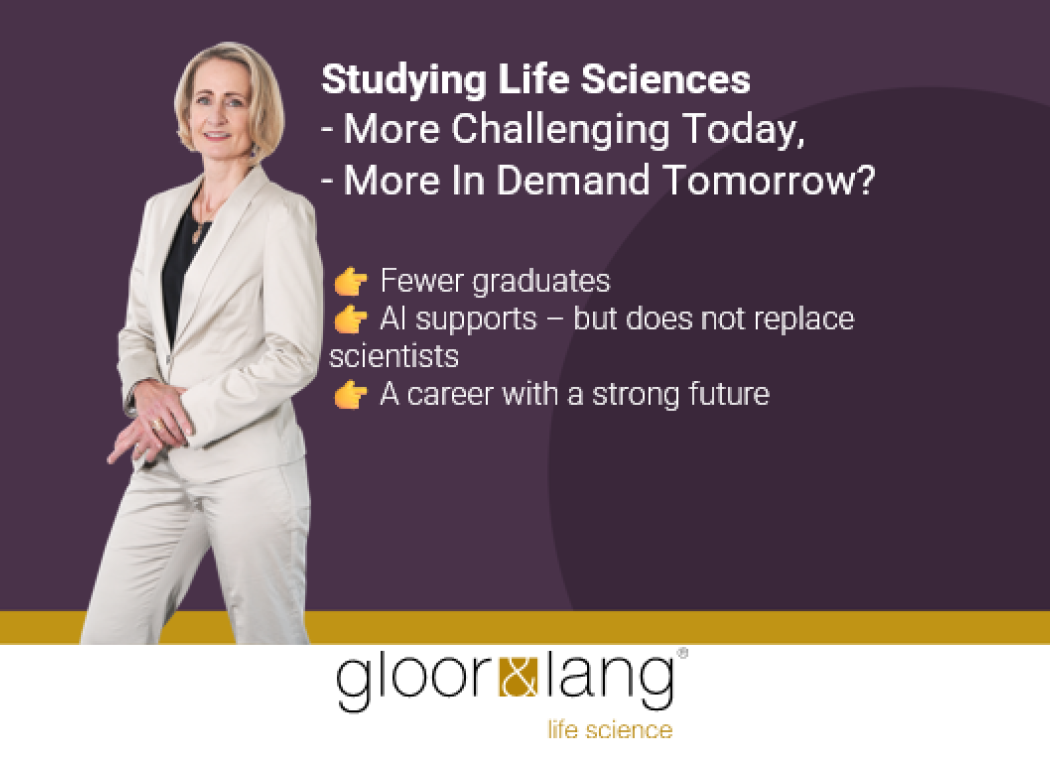
The Neue Zürcher Zeitung (NZZ) recently reported that fewer and fewer young people are choosing degrees in engineering and the natural sciences. Among the reasons cited are the demanding nature of these programs, the significant workload, and changing expectations among younger generations.
From the perspective of a recruitment consultancy that has specialized in the life sciences industry for many years, we currently observe an interesting paradox.
The Job Market Has Changed
Graduating with a degree in the natural sciences no longer guarantees an immediate path to a dream job. Especially for early-career professionals, the market has become more competitive. Companies are recruiting more cautiously than they did just a few years ago, and attractive entry-level positions now receive significantly more applications than before.
However, this does not mean that the demand for scientists is disappearing.
Quite the opposite.
Short-Term Market vs. Long-Term Demand
Labor markets move in cycles.
Today, graduates often need more patience when entering the workforce. At the same time, we are seeing fewer students choosing demanding degree programs such as chemistry, biotechnology, pharmacy, or engineering.
These two trends are unfolding on different timelines.
If fewer graduates enter the market while experienced specialists retire and emerging technologies require new expertise, the balance between supply and demand is likely to shift once again.
AI Will Change the Industry—But It Will Not Replace Scientists
Another important aspect is often overlooked.
Artificial intelligence will undoubtedly transform the life sciences industry.
It will:
- analyze data faster,
- support documentation,
- streamline research and development processes.
But AI will not:
- develop new drug candidates in the laboratory,
- design scientific experiments,
- interpret unexpected experimental results,
- take responsibility for GMP manufacturing or quality.
Innovation in the life sciences emerges where experimental data, scientific thinking, and practical experience come together.
AI will therefore become a powerful tool—but not a substitute for well-trained scientists.
An Important Question That Is Rarely Discussed
There is another issue worth considering.
Degrees in the natural sciences are among the most demanding academic programs available. They require perseverance, analytical thinking, and often many years of intensive education. Yet starting salaries are frequently not significantly higher than those in professions that require considerably less demanding training.
Perhaps this is a discussion society should also be having.
If we want young people to continue pursuing challenging scientific careers, the long-term return on that educational investment should also be reflected accordingly.
The Reality of the Swiss Life Sciences Industry
At the same time, the situation is complex.
Switzerland's life sciences manufacturing sector operates under intense international competitive pressure. Research and production compete globally, and salaries cannot simply increase without considering efficiency, productivity, and international competitiveness.
This tension will continue to shape the industry in the years ahead.
Conclusion
Today's job market should not be confused with tomorrow's job market.
Choosing a demanding degree in the natural sciences is not simply an investment in securing a first job—it is an investment in a career that can span decades within one of the world's most innovative industries.
From our perspective, a solid education in the life sciences remains one of the most valuable long-term investments anyone can make in their professional future. Those who choose to study life sciences are not simply choosing a profession—they are choosing to help shape the future of medicine, biotechnology, and pharmaceutical innovation.