


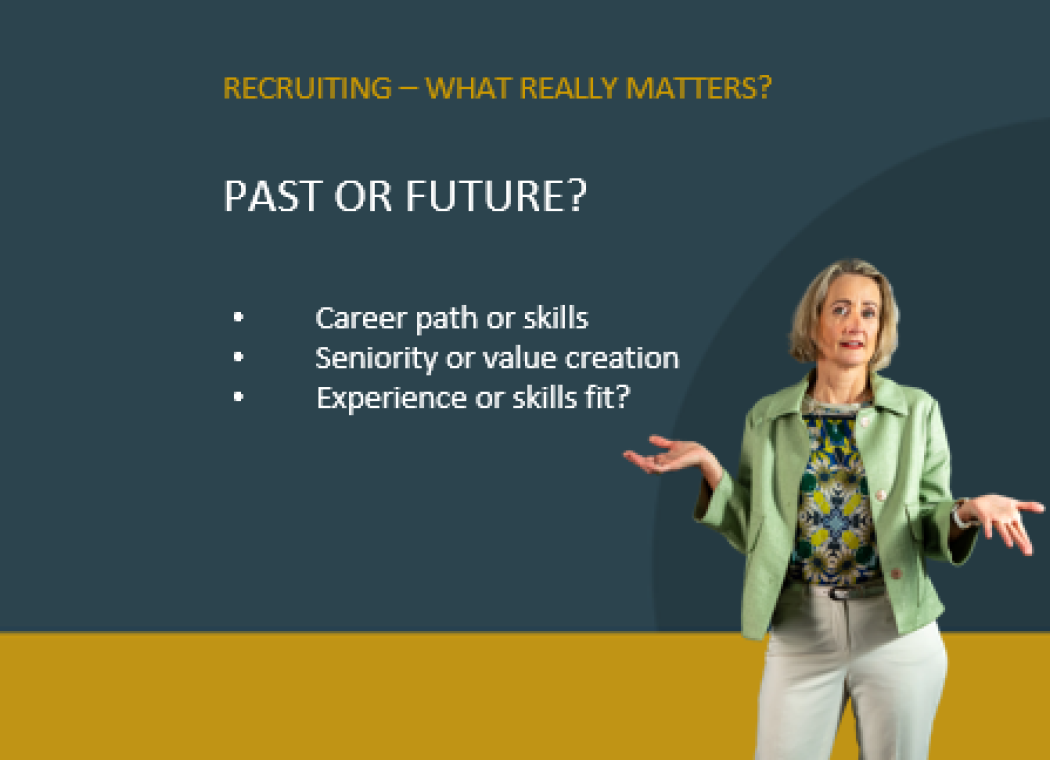
As early as 2019, I argued in a blog article that the traditional CV should be viewed as a Skill Sheet. Less emphasis on job titles, employers and career chronology, and more on what someone can actually do and has achieved.
Seven years later, I find myself reflecting on the same question from a different perspective: If relevant skills are what really matter, why do we still place so much emphasis on candidates' entire professional histories when assessing their suitability?
In my daily work as a recruiter in the life sciences industry, I encounter different recruitment cultures. These differences become particularly apparent when comparing international pharmaceutical companies with Swiss SMEs.
Two worlds of recruitment
In large pharmaceutical companies, often influenced by American corporate culture, I observe a strongly functional approach. A position is defined by specific requirements, and the goal is to find someone who can take on the role and perform successfully as quickly as possible.
- Does the person have experience in sterile drug product manufacturing?
- Are they familiar with the regulatory requirements for an NDA submission?
- Have they previously managed external manufacturing partners?
The focus is on "can-do": What skills does the person possess, how up to date are they, and what contribution can they make in the new role?
In Swiss SMEs, I more frequently encounter a different approach. Here, a candidate's entire career path tends to be examined more closely. Why did someone change jobs after two years? Why is there a gap in their CV? Does their educational background match the position? Could they be too experienced, too specialised or overqualified?
Of course, these are observations from my own professional experience rather than universally applicable distinctions. International corporations can also be extremely formalistic in their recruitment processes, while Swiss SMEs often make surprisingly pragmatic decisions.
Nevertheless, different underlying attitudes can be observed.
The United States has traditionally placed greater emphasis on career mobility and individual performance. In continental Europe, a continuous and clearly structured career path tends to carry more weight. Switzerland occupies a position somewhere in between: it has a relatively liberal labour market, yet retains a fairly traditional view of what an ideal CV should look like.
I find this remarkable.
How much of the past Is needed to make a good decision?
A CV documents professional experience. However, it does not automatically reveal how valuable that experience will be for the next role.
This distinction is particularly evident in the life sciences industry.
A professional with six years of highly relevant GMP experience may be better suited to an operational QA position than someone with 25 years of professional experience, several management positions and an impressive career.
Not because the additional experience is worthless, but because it may not provide any additional benefit for that specific role.
Conversely, an experienced manager may genuinely wish to return to an operational position. This is why I find the frequently used argument of overqualification only partially convincing.
What matters is whether the person can perform the role, genuinely wants to take it on, and has expectations that align with the conditions of the position.
Overqualification is not a skills problem. It only becomes a problem when expectations and requirements do not align.
A more role-focused assessment could also make career changes easier. Not every career has to follow a straight path, and not all experience needs to come from the same industry. What matters is which skills are transferable and which new competencies need to be developed.
That said, I certainly do not consider a candidate's professional background irrelevant. Motivation, reliability, willingness to learn and personal fit cannot be assessed solely from a list of technical skills.
But the order of priorities should be right: First, the role; then, the skills that are essential for it; and finally, the individual and their personal career story.
Salary discussions often follow the same traditional logic
This question becomes even more interesting when it comes to remuneration.
In many discussions, salary expectations are justified by a candidate's previous career. Education, years of professional experience, age, previous levels of responsibility and past salary are all used as points of reference.
But why should a role automatically be worth more simply because it is performed by someone with 25 rather than ten years of professional experience?
I would approach the question differently: What is this role worth to the company? What responsibilities does it involve, what problems need to be solved, and what value is the person expected to create?
In the life sciences industry, value creation does not necessarily mean generating additional revenue. Someone who reduces regulatory risks, stabilises production processes or enables a critical regulatory approval makes a significant economic contribution.
This contribution should play a major role in determining the value of a position.
If a company values a specialist role at CHF 130,000, it does not automatically become a CHF 160,000 position simply because a candidate with an extensive management career applies for it.
Additional experience can, of course, justify a higher salary if it creates corresponding added value. But seniority alone does not necessarily translate into value creation.
Conversely, a younger professional who takes on the same responsibilities and delivers the same performance should not be paid less solely because of their age or shorter career history.
Salary transparency also fits into this discussion. Several US states now require salary ranges to be included in job advertisements. The EU has also introduced new requirements through its Pay Transparency Directive. In Switzerland, however, disclosing specific salary information remains largely voluntary.
A clear, market-based assessment of a role would simplify many discussions. It would also help prevent candidates from being judged primarily on what they have earned in the past rather than on the contribution they can make in the future.
What can international pharmaceutical companies and swiss SMEs learn from each other?
I do not consider the American-influenced, strongly functional approach to recruitment fundamentally superior.
International pharmaceutical companies sometimes define their job profiles so narrowly that interesting candidates with related skills are barely considered. A specific technical or regulatory background becomes an exclusion criterion, even though relevant competencies might be readily transferable.
This is where I see a strength in many Swiss SMEs. They often take a more holistic view of candidates, consider motivation and personality, and are better able to appreciate individual career paths. This is particularly important in smaller organisations, where a single hire can have a significant impact on the entire team.
Conversely, Swiss companies could benefit from focusing more consistently on the competencies that are genuinely required.
- Which skills are essential?
- What must a person be able to do from day one?
- What can be learned?
- And which additional experiences, although impressive, are not actually necessary for the specific role?
Such prioritisation broadens the candidate pool and leads to a more objective discussion about suitability and remuneration.
This also has implications for how candidates present themselves. A CV should not primarily serve to demonstrate that a career has been as complete and linear as possible. Instead, it should highlight the skills and experience that are relevant to the desired position.
This is precisely why I introduced the term Skill Sheet back in 2019. The challenge today is no longer so much about explaining the concept, but about consistently applying it on both sides of the recruitment process.
Skills First – but not skills only
Skills-based hiring has been gaining importance in the United States for several years. However, a 2024 study by Harvard Business School and the Burning Glass Institute shows that there is still a significant gap between removing formal hiring requirements and actually changing recruitment decisions.
Apparently, it is easier to modernise job advertisements than to change our perceptions of what constitutes a successful career.
I also consider experience, education and career continuity to be important information. But they are not ends in themselves. They must be evaluated in relation to the role that needs to be filled.
The value of a candidate does not lie in the sum of all their previous qualifications, but in the contribution they can and want to make in a specific role.
Perhaps we should therefore spend less time examining the past for deviations from an ideal career path.
And more time discussing which problems someone can solve today.
Because we do not recruit for the past. We recruit for the future.
------------------------------------------------------------------------------------------------------------
Sources and Further Reading
Harvard Business School / Burning Glass Institute (2024) — Skills-Based Hiring: The Long Road from Pronouncements to Practice
European Commission – Pay Transparency — New EU Rules on Pay Transparency Explained